Tuesday, 4 October 2016

STRENGTHS-BASED PERSONALITY DEVELOPMENT PROGRAMME: FIRST: KNOW YOUR POTENTIAL


This is a unique and very powerful programme for the Personality Development for students and corporate leaders, managers and employees. There are existing programmes for the Strengths-Based Education and Career options for students. For the corporates there are programmes for the Leaders, Managers and Employees: covering the aspects like Talent Selection, Delegation, Talent Management, Employees’ Engagement and Employees’ Development. But there is no tailored made programme for the Strengths-Based Personality Development.
This idea came to me when one of universities requested me to carry out Personality Development Programme for their students. The format suggested was to take lectures or whatever be the programme for 60 to 70 students at a time------ more like motivational lectures. I refused to run such a programme. This triggered me to think about a Strengths-Based Personality Development Programme.
I conceived this programme in FOUR MODULES.  I conducted this programme for the students of the Christ University, Bangalore, India. To begin with, there were 35 Students out of these 27 Students completed the Programme and benefitted
Module 1 is eight hours programme called Individualised Strengths Based Development.

   The first part of the Programme was to “Know and Understand Yourself” what in the Gallup Strengths term called “Name it” and “Claim It”. It involved taking the Strengths Finder Test. It was done in the University Computer Lab. One of the students who took the test and attended the programme was a final year Under Graduate Psychology Student. After the test, he told me that he was very careful in taking the test lest his knowledge of psychology would have impacted his answers. But I suppose in 20 seconds he would have had very little time to think and his psychology background would not have influenced his responses. His five signature themes were:  ADAPTABILITY, RESTORATIVE, RESPONSIBILITY, STRATEGIC, SELF – ASSURANCE and after 6 hours (out of planned 8 hours) of sessions he commented, to quote “My behaviours and my actions have changed. Every action I take is to better myself. I have got more stable with my emotions and inner conflict don't really seen like conflict anymore. I am able to see things/situations/problems clearly and from all the angles. Although, I need to learn to tend to important & urgent works first. I got carried away by an unimportant things like a TV serial instead of focussing on the assignment. Otherwise I would have got much better at interpersonal skills.”


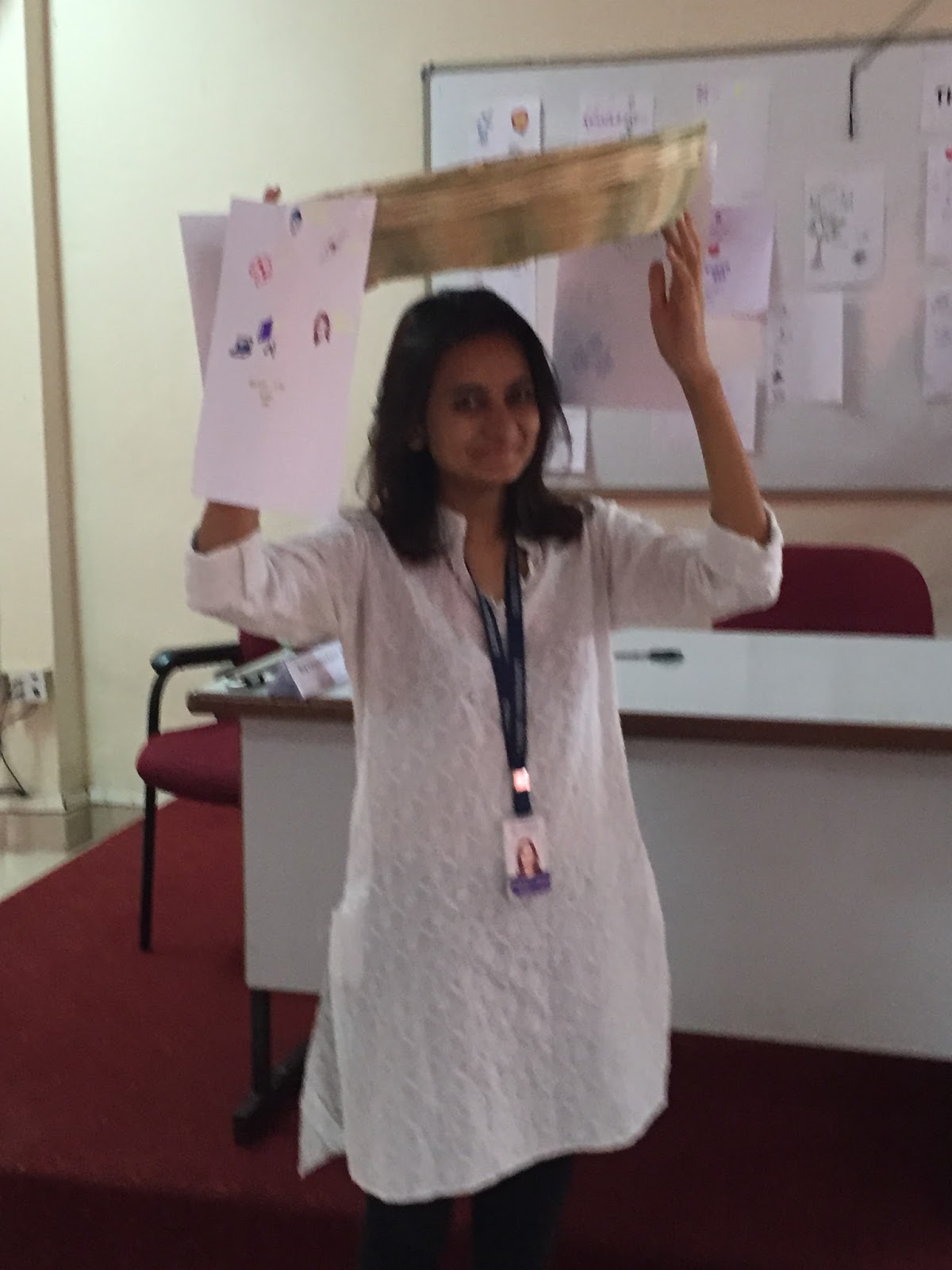
         During the next part of this Module, students went through the exercise of determining their Theme Dynamics, Theme Insight, reading and highlighting words and sentences resonating them from the Gallup Theme Insight Report. Followed by audio video presentation on all 34 themes. The high point of this part was when, they were requested to select their values from the value cards. Each student was given a set of 28 Value cards and they were asked to select their 5 Core Values. Most of them thought that all the 28 values belong to them. But gradually by sort listing, finally they came to their Five Core Values. When, they matched their values with Signature Themes, I asked them to draw their values. They were given a white sheet of paper with a set of coloured sketch pens. Many of them were confused or did not understand and they wanted hints from me. I did not give any hint, just repeated several times ‘”Draw Your Values”. 60 Minutes were given to them. Many of them had not done any drawing, may be after their primary schools but finally they all drew their values.  Each one was given one minute to explain their drawing of their values by presenting to the entire class. For many, it was their first chance of knowing their values and public speaking. One student asked me “Sir, please tell my father that I have values. He thinks I have no values”.
What students wrote about learning their values were very encouraging to me as facilitator and coach.
One student whose signature themes are EMPATHY, ADAPTABILITY, RESTORATIVE, HARMONY, DEVELOPER, wrote “this class has helped me figuring out my strengths and core values which will help me achieve my potential. I'm keen on finding out the areas I need to work upon and turn them into my strengths. I'm going to try out on completing all that I've written today”


       This module culminated with the Students knowing their domains and choosing their action points. One of the students whose signature themes are CONNECTEDNESS, HARMONY, ADAPTABILITY, EMPATHY, DELIBERATIVE, wrote:
“Since last week, I have started discovering new things about my personality, my approach to a situation and also my thought process. For this week I have given myself a set of tasks that I will start implementing and I hope to achieve them in every way”.
    Likewise, I can go on narrating my experiences of running this module with the overall aim to use the strengths to develop the personality of students. The basic concept is based on the positive fact that one must know his/her potential prior to developing oneself. How can anyone develop himself/herself or even a coach or a mentor develop a person without knowing as to what are the potential of the person whom they are to develop?


Other Modules in the Next Blog.


Wednesday, 27 July 2016

Strengths Based Personality Development Programme for University Students

This programme has been conceived, developed and conducted my me.

I am attaching the link to the pictures of the programme. These pictures speaks volumes.


https://goo.gl/photos/tUfgApPzfz5cyFaL7


https://goo.gl/photos/tUfgApPzfz5cyFaL7

Sunday, 17 July 2016

How to Uphold Your Values? Way shown by the Media Students of the Christ University, Bengaluru

Students Discovering their Values with the help of Gallup Value Cards


Drawn  their Values


Carrying Values on their Heads


Carrying Umbrellas of Values


And finally, Values on the office boards visible to all


Sunday, 26 June 2016

You Can Achieve Greatness: Special module for Students

1.         Most people wonder what this Strengths Development is. The process of Strengths Based Development determines his or her talents and strengths that lead to success.
2.         All of us are born with unique talents. Talent has been defined as “a naturally recurring pattern of thoughts, feelings or behaviours that can be productively applied”. These talents are discovered by taking Clifton Strengths Finder Test. Coaches guide the participants, as how to convert their talents into strengths and how to leverage these strengths to achieve their desired SMART goals. These steps lead to Strengths Based Development.
3.         This concept is applicable to individuals, managers, teams, leaders and students of colleges and universities.
4.         People when performing from their strengths zones are positive, creative, innovative resulting in greater production, they become willing workers and they enjoy the work.
6.         College students, besides knowing their strengths, they will become focused towards their desired and SMART goal(s). They will know their domains of strengths and work in that direction. Students will realise that they are not made out of cookies cutter, but they are all unique and differences are advantage. They are individuals and they can achieve same goals by different behaviours.
8.         The strength has been defined as the ability to consistently provide near perfect performance; the ability to consistently produce a positive outcome through near perfect performance in a specific task. To finish with strength, start with talent.

9.         Why do students require Strengths – Based Development Training: there are reasons for this is success. Success will come by
(a)  Discovering your talents.
(b)  Understanding your talents.
(c)  Converting your talents into strengths.
(d)  Leveraging your strengths to achieve their goals
(e)  Understanding your Domains of Strengths.
(f)   Early identification of your strengths will lead you to the right path of success.
(g)  Working from your strengths zone and be fully engaged.
(h)  By becoming driver and not be driven by someone else.
(i)    Improving your ability to take an interview confidently.
(j)    Their best bet for success lies in building on who you already are, not in trying to become someone you’re not.

(k)  This will be able to bridge the gap between the teachings at the universities/colleges and the real world outside the university campus.


Monday, 13 June 2016

How to become the most successful student, dignified employees, respected managers and leaders?

 Module 1. Individualised Strengths Based Development Programme
            (a) Taking Online Clifton Strengths Finder Test
            (b)  Coaching Group of 20: full day

Module 1 is an interactive session for 8 hours with 20 participants. This will involve online test and then being coached based of their respective individual talents. The learning values are (participants will)
            (a)       Know their talents
            (b)       Understand their talents
            (c)        Learn how to convert these talents into strengths
            (d)       Learn how to leverage their strengths to achieve their goals
            (e)       Learn how to make an Individual Development Plan
            (f)        Know their strengths domains.

Module 2.Strengths Based Team building Programme

            (a) To be conducted after Module 1
            (b) Exercise: PANCHTATVA
            (c) Group of 20: 2nd day

Module 2 named as PANCHTATVA will be conducted only after the completion of Module 1. It is a full day interactive workshop (exercise) in which participants will be exercised on various facets of team building and managerial skills. PNACHTATVA is based on the backdrop of SMART CITY. The participants will learn
            (a)       To determine strengths and domains of a team
            (b)       Strengths Based Talent selection
            (c)        Strengths Based Talent Engagement
            (d)       Strengths Based Leading Performance
            (e)       Strengths Based Talent Development
            (f)        How to increase the OPEN AREA on the Johari’s window?
            (g)       How to create an interdependent team?
            (h)       How to create a STRONG Team?

Module 3: Strengths Based Leadership

            (a) To be conducted after Modules 1 & 2
            (b) Exercise: CHAMATKAR
            (c)  Group of 20: 3rd Day
Module 3, named as CHAMATKAR will be conducted after the completion of Modules 1 &2. It is a full day interactive workshop (exercise) in which the participants will be exercised on various facets of leadership. It based on the concept that everyone is a leader only if they work in their respective strengths zones. They will reach dizzy heights only if they perform in their strengths zone. It is again in the backdrop of a SMART City. The participants will learn
            (a)       Why people follow?
            (b)       How to build an organisation/team with Trust, Compassion, Stability and Hope?
            (c)        How to leverage their Strengths to achieve Trust, Compassion, Stability and Hope?
            (d)       How to lead followers working from different Strengths Zones?

Programme being delivered by Gallup Certified Coach, Brig Satyendra Kumar, SM (Retd).   For details visit:  www.satyssparks.com,

For inquiry write to:  satyssparks@gmail.com or contact: +91 9900073571

Who will benefit the most?

·         College Students of all streams


·         Newly inducted Managers,  Middle Level Managers, Team Leaders—operational, marketing, sales and research teams and HR (Talent Selection, Talent Engagement, Team Building, Performance Management away from the dreaded Bell Curve and Talent Development)

Thursday, 2 June 2016

WHOM SHALL I follow? Which leader shall I follow? FOLLOWED myself.


When I learnt to read, the first influential story that I read was of Mahabharata and I thought I am reincarnation of Krishna. He even appeared in my dream. Later when I grew up a little, I tried to emulate Arjun or Karna. When my teachers gave lectures that one day one of you will be Mahatma Gandhi or Jawahar Lal Nehru, I thought of following them. Much later in life when I read “My Experiment with Truth” I thought I have read the best book on leadership and truth. I tried to follow it, but in the practical world of diplomacy, truth was the first casualty. But yes, practise what you preach is glued to my head which even nuclear fission cannot disintegrate it.
In the National Defence Academy, we had to study a subject called Military History. One civilian Instructor named Mr Bhandari used to teach this subject to us. He came fully prepared and kept us engrossed for 40 minutes with a chalk in his hand making sketches on the board and explaining. Till now I am trying to emulate him.
When I was a Subaltern (a junior officer) in the battalion, I tried to emulate my senior subaltern then Lt Vilas Baburao Zende and my Company Commander then Maj CG Shambaya.  Whenever, I faced a challenging situation(s), I tried to think as to how they would have acted/reacted.
In military history, I studied various campaigns of great warriors and military leaders. Immediately on completion of the study, I thought I was Alexander the Great or Julius Caesar. On several occasions I tried to emulate the manoeuvres of Rommel, Patton and Guderian but these ended in disastrous consequences.
Some time back, I read in the Readers Digest, an essay on Empathy by Roman Krznaric. I bought his book “Empathy—what it matters, and how to get it”. I did not only read it but studied it and converted the book into a Power Point Presentation. In this he made reference to several  empathetic books like “Uncle Tom’s Cabin” by Harriet Beecher Stowe, “Schindler’s Ark” by Thomas Kennelly, “Black Like me” by John Howard Griffin, “The General’s Son—Journey of an Israeli in Palestine and finally “All Quiet on the Western Front” by  Erich Maria Remarque. I read and studied all the books mentioned by Roman Krznaric. Also read the articles about Che Guevara who wanted to become a medical doctor but became an empathetic terrorist; the story of Patricia Moore; an empathetic designer: Eric Lomax, a British prisoner in Burma during the Word War II and his tormentor in the camp, the Japanese Translator Takashi Nagase who beg forgiveness to Eric after 48 years in 1993. The list is endless including Mahatma Gandhi, Mother Teresa, Nelson Mandela, George Orwell, Gunther Wallraff, to name few, but study of these great Empathetic personalities did not make me empathetic. I also planned to build a Human Library in the society but did not follow it with vigour. Why this? I read and learnt a lot about empathy and empathetic personalities, but still I did not become empathetic. I got the answer when I took the Clifton Strengths Finder Test. Empathy was at number 9 out of 10 for me.
I am Empathetic but not always. It is a supporting talent for me. It is much below my top five: Learner, Achiever, Strategic, Arranger and Input. Discovery of these talents (some of these are already my strong strengths) gave me identity as to who I am. Why do I think, feel and behave the way I naturally do? My talents gave me insight into as to why I could not follow the great leaders naturally. While considering retrospectively, all my success in professional and personal lives are attributed to these talents and strengths. The failures are as a result of not working within my strengths zones. I failed when trying to emulate someone else. I failed because I tried to do what I was not.


So I am a Learner, Achiever, Strategic, Arranger and Input. This is my identity. I will not follow anyone. I will follow myself ie my thoughts, feeling and behaviours that come naturally to me.

Monday, 30 May 2016

STRENGTHS BASED APPROACH CAN MEET THE CHALLENGES OF MILLENNIALS

11.   Millennials are the youngest workforce born between 1980 and 1996. The millennial generation is now the largest, most ethnically diverse generation in American history……..Daron/The Washington Post.

22. This is with the reference to two articles one in The Washington Post “How badly companies misunderstand millennials” by Niraj Chokshi and second a post in LinkedIn “Working with Millennials? Gallup Says Everything You Think You Know Is Wrong” by Bill Murphy Jr.

33.Here are the seven leadership changes Gallup came up with:
(a)  The change from “my pay check” to “my purpose.”
(b)  The change from “my satisfaction” to “my development.”
(c)  The change from “my boss” to “my coach.”
(d)  The change from “my annual review” to “my ongoing conversations.”
(e)  The shift from “my weaknesses” to “my strengths.”
(f)   The change from “my job” to “my life.”

(g)  They are constantly looking for “something else.”

Adapt to the Changes
14,Initially, for the survival and subsequently to continue performing, entire concept requires change. Adoption of new concept based on Strengths models requires real and genuine transformational leaders. “Millennials want a workplace that helps them progress, but they also want to see their own value,” said Jim Harter, Chief Scientist for work place management and well-being for Gallup’s workplace management practice. “Giving out toys and entitlements is a leadership mistake, and worse, it’s condescending,” Gallup Chairman and Chief executive Jim Clifton writes in the report. “Purpose and development drive this generation”

 5. The illustrations below amply shows the directions the Universities/Educational Institutions and Industries should take to meet the aspirations of the Millennials.