Saturday, 14 May 2016

Managers and Leaders Must be Open and Transparent

There are four areas that are significant when the mangers and leaders must be open and transparent. Many leaders and managers think that his or her subordinates do not know and will not know. They are sadly mistaken. One of a very dynamic and successful military leader has said that “One must never make a show of false emotions to one’s men. The ordinary soldier has a surprisingly good nose for what is true and what is false”…… Field Marshal Rommel.  In the corporate world, men and soldiers could be substituted as employees or subordinate staff or members of the team.

How to make the managers and leaders open and transparent?
Acknowledgement. The basic illustration has been taken from the Johari Window from the Gallup Workbook “Coaching Strengths: Accelerated Strengths Coaching: Understand and Guide Support Empower”.  Other illustrations and pictures are self- created.

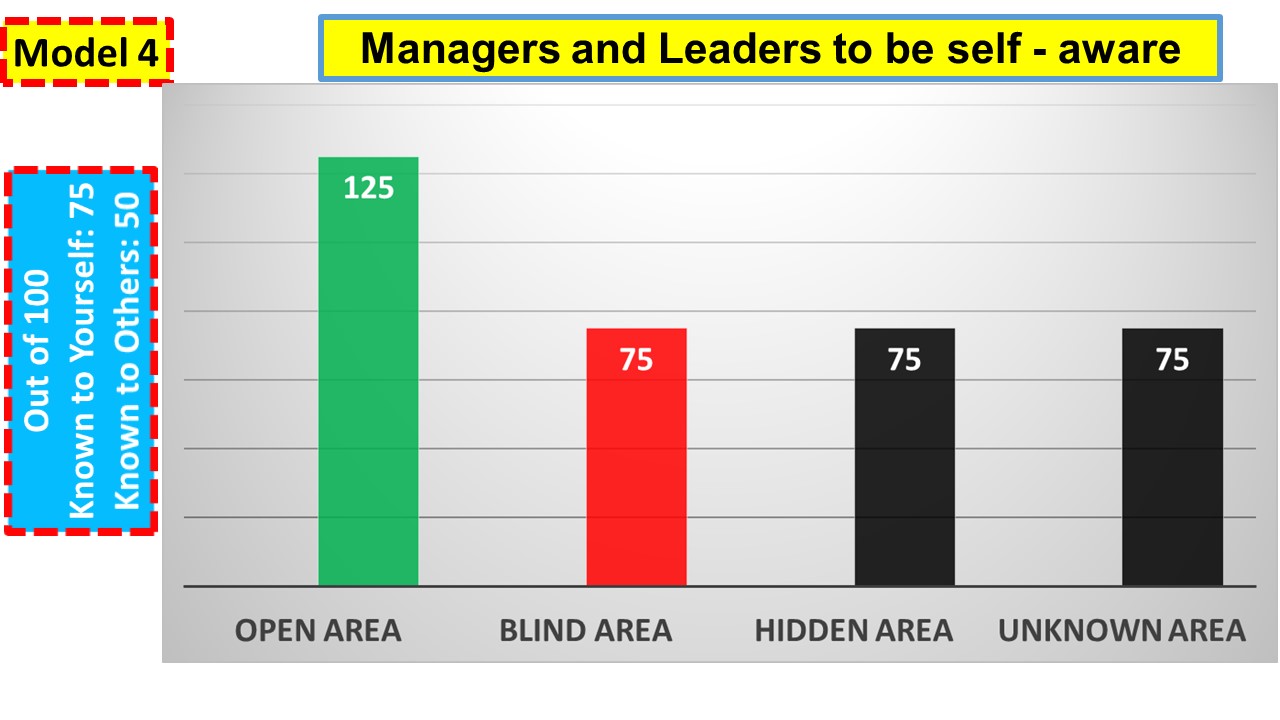
The scale is of 100: ie the leader has 100 talents/skills/values out of these 100, some are known to him or her and some are known to others.  There are six graphical models illustrated below.

Readers can observe as how the open areas increase gradually. These represent the thoughts, feelings, and behaviours that the mangers and leaders know about himself or herself. It includes the talents, strengths, weaknesses and transparent behaviours that are known to her or him and others.  As a coach, it is my endeavour to increase the open and transparent area of managers and leaders. A manager or a leader is most effective and productive when he or she is open and transparent about his or her strengths, weaknesses, emotions and intentions. 
I recommend, that all managers and leaders should strive to reach as illustrated in Model 6.  Beyond this is that known to yourself and known to others will be 100% which may not be feasible due to “need to know principle and competitive nature of environment.


Friday, 13 May 2016

Strengths Based Recruitment

One of the four roles of a manager is the recruitment/talent selection; other three being employee engagement, performance management and development. All the four are interdependent but it all begins with the recruitment of the right talent.

Mere university qualifications and experiences are not adequate to have dedicated employee engagement resulting in near perfect performance almost every time. It has been found out by the Gallup survey that only 13% of the work force in the world are fully engaged and rest 87% are not.

According to Gallup, the definition of Strengths is the “ability to consistently provide near – perfect performance; ie the ability to consistently produce a positive outcome through near perfect performance in a specific task. To finish with strengths, start with talents”.
Recruitment of right talent is the first step to get near perfect performance consistently. This will happen only if the employees are working from the strengths zones.

How to go about it?
·        Recruit and select candidates with talents that match those of the best performers in each role.
·        Find employees with the highest potential for excellence.

·        Assess and select job candidates for “Talents” and right “domains” for the workgroup and culture.


Tuesday, 3 May 2016

ANCIENT LINKS TO STRENGTHS BASED DEVELOPMENT

T It was around 300 BCE when Chanakya discovered the talents of Chandragupta Maurya. Chanakya coached him, skilled him and educated him to propel him to one of the greatest emperor of India.
2
2 The second example is from Ramayan. Please watch the link. It does not require any explanation, when Hanuman was reminded of his forgotten Strengths

3 The third one is from the Movie Ten Commandments, when Moses was made to discover his strengths to liberate 40,000 enslaved Jews to the Promised Land. Please watch the link

4  The fourth one is more recent one, is the poem written by famous Urdu poet Iqbal of Sare Jahan se Achha  fame ; he wrote

             खुदी को कर बुलन्द ईतना के हर तक़दीर से पहले
            खुदा बन्दे से पूछे, बता तेरी रजा क्या है।

Khudi Ko Kar Buland Itna Ke Har Taqdeer Se Pehle
Khuda Bande Se Khud Puche, Bata Teri Raza Kya Hai
5.      Means
Develop the self so that before every decree
God will ascertain from you: “What is your wish?”


Above four examples amply prove that we all must know our talents to further develop these into strengths to achieve our desired SMART goals.


Tuesday, 19 April 2016

Special module for students: Students are not made out of cookies cutter.


1.  Most people wonder what Strengths Based Development is. The process of Strengths Based Development identifies his or her talents and strengths and develops them to ultimately lead to success in life.
2.         All of us are born with unique talents. Talent has been defined as “a naturally recurring pattern of thoughts, feelings or behaviours that can be productively applied”. These talents are discovered by taking the Clifton Strengths Finder Test. Coaches guide the participants, to convert their talents into strengths and leverage these strengths to achieve their desired SMART goals. These steps lead to Strengths Based Development.

3.         This concept is applicable to individuals, managers, teams, leaders and students.

4.         Individuals when performing from their strengths zones are positive, creative and innovative, resulting in greater production as they become willing workers and enjoy the work.
6.       Students, besides knowing their strengths, will become focussed towards their desired and SMART goal(s). They will know their domains of strengths, and work in that direction. Students will realise that they are not made out of a cookies cutter, but they are all unique in their own way. They are individuals and they can achieve the same goals by different behaviours.
8.         Strength has been defined as the ability to consistently provide near perfect performance; ie the ability to consistently produce a positive outcome, through near perfect performance in a specific task. To finish with strength, start with talent.

9.         Why do students require Strengths  Based Development Training?
Because it will lead to success! Success will come by
(a) Discovering your talents.

(b) Understanding your talents.

(c) Converting your talents into strengths.


(d) Leveraging your strengths to achieve their goals

(e) Understanding your Domains of Strengths.

(f)  Early identification of your strengths will lead you to the right path of success.

(g) Working from your strengths zone and being fully engaged.

(h) By becoming the driver and not being driven by someone else.

(i)   Improving your ability to take an interview confidently.

10.    Your best bet for success lies in building on who you already are, not in trying to become someone you’re not.

11.    This process will be able to bridge the gap between the education acquired at the universities/colleges and the real world outside the university campus.


Saturday, 16 April 2016

People when performing from their strengths zones are positive, creative, and innovative

Most people wonder what this Strengths Based Development is. Strengths Based Development involves determining one’s talents and strengths that lead to success.

All of us are born with unique talents. Talent has been defined as “a naturally recurring pattern of thoughts, feelings or behaviours that can be productively applied”. These talents are discovered by taking Clifton Strengths Finder Test. Coaches guide the participants, as how to convert their talents into strengths and how to leverage these strengths to achieve their desired SMART goals. These steps lead to Strengths Based Development.

This concept is applicable to individuals, managers, teams, leaders and students of colleges and universities.

People when performing from their strengths zones are positive, creative, and innovative; resulting in greater production; they become willing workers and they enjoy the work.
Managers will discover their unique talents for the greater team engagement. They will become high performing managers in all the four basic fields of their responsibilities ie Talent Selection, Employee Engagement, Performance Management and Development. On the Johari’s window, it will increase the open area and reduce the blind spots, hidden and unknown areas.

Strengths Based module for the team and manager will determine the DNA of the team, employees’ engagement, and performance management. It will make a team totally interdependent, which is the best for sustained excellence. The team will become focussed on its goals, will prioritise the tasks, and the excellence will be more pronounced in a multicultural environment. The team will become magnet of talent and the members of the team will not only show diligence to profession but will lead happy social and family life. The manager and the team members will realise that they are not made out of cookies cutter, but they are all unique and differences are advantage. They are individuals and they can achieve same goals by different behaviours.

Most effective leaders always invest in their strengths. Strengths Based Leaders will be able to provide stability, trust, hope and compassion to employees of the organisation.


Strengths Based Development makes everyone realise their strengths, and brings an awareness that the best bet for success lies in building on who they already are, not in trying to become someone they’re not.


Finally, the strength has been defined as the ability to consistently provide near perfect performance; the ability to consistently produce a positive outcome through near perfect performance in a specific task. To finish with strength, start with talent.

Saturday, 2 April 2016

Applicability of Strengths Based Development

How will it help Individual?
  • They will know themselves – will know their talents.
  • They will be able to convert their talents into strengths.
  •  They will be able to leverage their strengths to achieve your desired and
  • SMART goal(s).
  • They will work in their respective strengths zones and be fully engaged.


People working in the strengths zone:
  • Look forward to going to work
  • Have more positive than negative interactions with co-workers
  • Treat customers better
  • Tell their friends they work for a great company
  • Achieve more on a daily basis
  • Have more positive, creative, and innovative moments

How will this benefit managers?
  1. It will help mangers to discover, develop and use their unique talents for greater team engagement and productivity;
  2. It will help managers identify how they can purposefully aim their talents so that team members both individually and collectively, are better equipped to accomplish their goals and performance objectives and respond to every situation;
  3. Managers will be able to recruit and select candidates with talents that match those of the best performers in each role and to find employees with the highest potential for excellence;
  4. Mangers will be able to create a working environment where employees are involved in, committed to, and enthusiastic about their work and the organisation as a whole;
  5. Managers will be able to help employees meet and exceed the outcomes that the organisation expects them to achieve.
  6. Managers will be able to support employees in gaining the knowledge, skills and experiences they need to develop their talents and use their strengths to achieve proficiency and excellence in their roles.
How will it benefit the Organisation?
  1. When a manger understands, appreciates, and invests in team members’ strengths, his or team tend to be more productive and engaged.
(a)  Teams that focus on strengths everyday have 12.5% greater productivity:
(b)  People who focus on using their strengths are SIX TIMES more likely to be engaged in their jobs.
2. When managers influence and inspire engagement, their jobs become easier and their teams are more productive.
(a)   Workgroups with high employee engagement levels experience 22% higher profitability and 21% higher productivity;
(b)  Teams with high employee engagement levels experience 37% lower absenteeism and 10% higher customer ratings.
3. When managers help their employees create clear performance expectations and regularly check in on progress and performance, their employees and teams become more productive, cost effective, creative and adaptive.

 How will it help Students?
  1. Discover their talents.
  2. Understand their talents.
  3. Convert these talents into strengths.
  4. How to leverage their strengths to achieve their goals?
  5. Understand their Domains of Strengths
  6. .Early identification of their strengths will lead them to the right path of success.
  7. 7.    Will enable them to work from their strengths zone and be fully engaged.
  8. Will help them to become driver and not be driven by someone else.
  9. Will improve their ability to take an interview confidently.
  10. 10 Their best bet for success lies in building on who they already are, not in trying to become someone they’re not.

Wednesday, 30 March 2016

Strengths Based Development, Strengths Based Leader, Strengths Based Team, Strengths Based Manager


       Yes, even the entire life of a living being is based on strengths. When the strengths start diminishing along with it diminishes the life. One who develops on strengths last longer in the work which he or she likes.

    Most people think they know what their strengths are. They are usually wrong. And yet, a person can perform only from strengths. (Business Guru Peter Drucker). The key to success is to fully understood how to apply one’s greatest talents and strengths in everyday life.
Training for the Strengths Based Development involves, taking on line strengths finder test, which determines the participants’ five signature talents also called themes. Coaches of www.satyssparks.com, make participants understand their talent themes, how to convert these into strengths and finally how to leverage these strengths to achieve their desired goals.

        In 340 BCE, Chanakya discovered the talents of Chandragupta Maurya. Chanakya invested in his talents by training him, developing his skills and finally made him the first emperor of India. Chanakya invested in his strengths to make him the king. Similarly, Clifton Strengths Finder Test discovers the talents of individual; and guides how to invest in these talents to covert as their strengths that will lead to success in life.
According to Hindu mythology Hanuman was made to discover his forgotten (due to curse) strengths and flew to Lanka. According to Christianity/Judaism was reminded by the voice of God that he had the strengths to liberate 40,000 Jews from the enslavement. He achieved his goal of liberating and leading Jews to Sinai.

       In above cases all the three worked from their Strengths Zones to achieve their objectives. Today, people working from the Strengths Zone:
ü  LOOK FORWARD TO GOING TO WORK;
ü  HAVE MORE POSITIVE THAN NEGATIVE INTERACTIONS WITH COWORKERS;
ü  TREAT CUSTOMERS BETTER;
ü  TELL THEIR FRIENDS THEY WORK FOR A GREAT COMPANY;
ü  ACHIEVE MORE ON A DAILY BASIS;
ü  HAVE MORE POSITIVE, CREATIVE, AND INNOVATIVE MOMENTS.

Strengths based development is applicable to students of college and university levels of all discipline. It will benefit the students:
Ø  Discover their talents.
Ø  Understand their talents.
Ø  Convert these talents into strengths.
Ø  How to leverage their strengths to achieve their goals?
Ø  Understand their Domains of Strengths.
Ø  Early identification of their strengths will lead them to the right path of success.
Ø  Will enable them to work from their strengths zone and be fully engaged.
Ø  Will help them to become driver and not be driven by someone else.
                  Will improve their ability to take an interview confidently
Ø         Their best bet for success lies in building on who they already are, not in trying to become someone they’re not

Strengths based development is not running 100 metres race. It is a lifelong. It applies to leaders, managers and teams. Its determination and application in appropriate way helps a leader to lead with stability, compassion, trust and hope. The team becomes focussed by prioritising the tasks, can work in different cultural environment, the team gives equal weightage to professional and family life. The team becomes magnet, which operates as interdependent team with respect and dignity for each other.
The most benefited by this is a manager of an organisation at any level and these are:
*      to discover, develop and use their unique talents for greater team engagement and productivity;
*      to identify how they can purposefully aim their talents so that team members both individually and collectively, are better equipped to accomplish their goals and performance objectives and respond to every situation;
*      will be able to recruit and select candidates with talents that match those of the best performers in each role and to find employees with the highest potential for excellence;
*      will be able to create a working environment where employees are involved in, committed to, and enthusiastic about their work and the organisation as a whole;
*      will be able to help employees meet and exceed the outcomes that the organisation expects them to achieve.
*      will be able to support employees in gaining the knowledge, skills and experiences they need to develop their talents and use their strengths to achieve proficiency and excellence in their roles.

Strength is the ability to consistently provide near-perfect performance. It is the ability to consistently produce a positive outcome through near-perfect performance in a specific task. To finish with strength, start with talent. (Knowledge + Skill +Talent) x Investment = Strength. Therefore working in the Strengths Zone shall always bring consistent performance which shall be near perfect again and again.

The training organised by www.satyssparks.com  has four levels (i) for students (ii) for Managers and Leaders (iii) for Teams and (iv) Individuals.
The coaching is conducted one on one basis, in groups of 10 and 20. Face to face coaching is the best, however coaching is also done on WebEx and skype.


Coaching MBA Students on Strengths Based Development